
Click on the image to view a high resolution image.
To return to thumbnails, use your computer's "back" button.
| Type: | clothing | ||
| Ethnic Group: | Hausa | ||
| Country: | Nigeria | ||
| ECU Number: | L0131 | ||
| |||
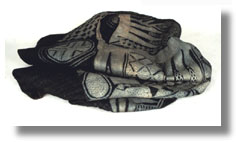
| Description: | This embroidered Hausa robe from Nigeria is dyed with indigo, and has white embroidery in geometric forms. Moslem influence is every evident in the designs which erfer to good fortune, victory in war, political authority, and protection against evil. Passages are taken from the Koran and magic rites. | ||
| Significance researched to date: | This robe was made by the Hausa, a group in northern Nigeria who are strongly Moslem. This is a prestigious garment made of hand-woven, dyed and embroidered cloth. Weaving among the Hausa was reported in the 15th century, and embroidery in the early 19th century by missionaries and travelers. Designed and produced by men, these robes of honor were made for men of high status and royalty to signify wealth, social status, religious piety, or political authority. Robes were used as gifts from officials to their subordinates, objectifying the relationship and symbolizing protection. The makers were traditionally scholars of the Koran who learned to produce such robes through apprenticeship training. The cloth used was either cotton or silk, and the embroidery thread was silk or gold. Women and slaves processed and spun the thread and wove the cloth. Today, cloth is imported and dyed with indigo dye. Traditionally, women gathered the leaves of a bush called tinto, crushed it in large mortars, and rolled it into balls which were dried in the sun. The balls were crushed and mixed with water and ash. This was dried again and the outer part crushed and used for the dye. Cloth was dipped in and out of the dyebath until the desired color was achieved. Exposure to oxygen created the blue color. A very similar process is still used today in Africa. When the embroidery is complete, a wooden mallet is used to beat the threads until they are shiny. Patterns used refer to good fortune, victory in war, political authority, or protection against evil. Passages are taken from the Koran and magic rites. The knife pattern, elongated triangles, and a spiral motif are commonly used and are seen on this robe. The knife pattern refers to swords used to destroy evil of the enemy (put out the eyes of the enemy.) The spiral motif with a crossed circle is thought to have protective qualites; it is used on pendants, weapons, and mosque walls. | ||