
Click on the image to view a high resolution image.
To return to thumbnails, use your computer's "back" button.
| Type: | mask | ||
| Ethnic Group: | Hemba | ||
| Country: | Democratic Republic of Congo (Zaire) | ||
| ECU Number: | L0015 | ||
| |||
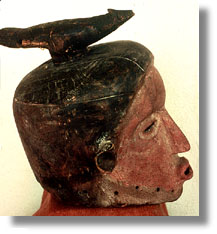
| Description: | This wood helmet mask, made by the Northern Suku or Hemba, has a zoomorphic crown projection and pigments. The bell-shaped form was adopted from neighboring ethnic groups, with representations of men or animals added on the pinnacle, inspired by the kholuka masks of theYaka. | ||
| Significance researched to date: | This bell-shaped mask originates with the Northern Suku, who live by the Luie and Lukula Rivers. They are referred to as Hemba. The variety of Hemba styles is linked to the migrations of these people. It is believed that the Suku adopted bell-shaped masks from their neighboring ethnic groups and then added representations of a man or animal on their pinnacles, inspired by the kholuka, circumcision masks of the Yaka, which allude to themes of procreation or domestic activity and have conical extensions and puppet-like human and animal figures on the crown. (Cornet, 112, Felix, 166,167) | ||