
Click on the image to view a high resolution image.
To return to thumbnails, use your computer's "back" button.
| Type: | musical instrument | ||
| Ethnic Group: | Bushoong | ||
| Country: | Democratic Republic of Congo (Zaire) | ||
| ECU Number: | L0054 | ||
| |||
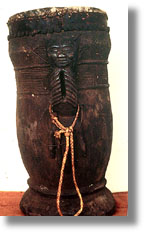
| Description: | This wood drum from the Kuba clan has carved geometric Kuba designs, a handle carved with a stylized face and hand, and a skin drumhead. The face has scarification marks on the cheeks and forehead. Drums are an important instrument, used to send messages, call hunters to the hunt and warriors to war, and providing rhythms to accompany singers and dancers. | ||
| Significance researched to date: | Drums are the most important instruments in Africa. They are diverse in construction and produce the most dominant sound. They have been very important in village and court activities. Made of wood, they comprise two basic groups--skin drums and slit drums. Skin drums are made by stretching hides over wood; slit drums are made entirely of wood. Some slit drums consist of sections of tree trunks, and others are constructed boxes. Large ÒtelegraphÓ slit drums were used to send messages from one village to the next, up to 15 miles apart, concerning births, deaths, graduations, feasts, the arrival of visitors, or court ceremonies. They also called hunters to the hunt and warriors to war. Because of their large size, they were never moved. The king used drums to reinforce his power and prestige, as a part of his regalia. Beating out polyrhythms, they accompany singers and dancers in royal, religious, and social events. This ceremonial drum, constructed of a single piece of wood, has carved geometric Kuba designs on the top and a carved handle on the side featuring a stylized human face extending into a hand. The face has scarification marks on the cheeks and forehead. An animal hide is stretch over the top and sewn into the cylinder base. It originated with the Bushoong, a clan within the Kuba kingdom consisting of over 100 villages. (Schweinfurth quoted in Sieber, 111, Wassing, 146,156) | ||