
Click on the image to view a high resolution image.
To return to thumbnails, use your computer's "back" button.
| Type: | musical instrument | ||
| Ethnic Group: | Unknown | ||
| Country: | Democratic Republic of Congo (Zaire) | ||
| ECU Number: | L0170 | ||
| |||
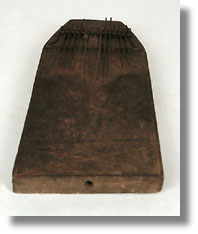
| Description: | This wood sanza, of rectangular form, has iron keys. Sanzas are used all over the Congo, usually for entertainment rather than ritual purposes. They have a varying number of keys, played in a variety of tunings. The size of the box determines the resonation. The iron keys vary the pitch. The keys rest above the wood box on a metal strip, and are plucked with the thumb. | ||
| Significance researched to date: | A well known instrument, this type of ÒpianoÓ is used all over the Democratic Republic of Congo. Nearly every ethnic group created its own version. Sanzas have a varying number of keys, played in a variety of tunings. They are played with the thumbs and by alternately opening and closing the back hole with the middle finger of the left hand. The size of the box determines the resonation; the metal stripsdetermine the pitch. The music is strongly polyphonic. Contrapuntal melodic lines are played and sung simultaneously, creating polyrhythms. Sanzas are usually used for music for entertainment rather than for ritual purposes, and are are often played along with stick zithers and small harps or rattles. Individuals or small groups, often young boys or girls, gather and Òjam.Ó Love songs or ballads are usually played. This sanza is made of a solid piece of wood with 18 iron keys of 14 different lengths which vary the pitch. The shorter keys produce a higher pitch, and the longer keys, a lower pitch. The keys rest above the surfaceof the wood on another metal strip and are plucked with the thumbs. The edge is carved with typical Kuba parallel diagonal lines. | ||